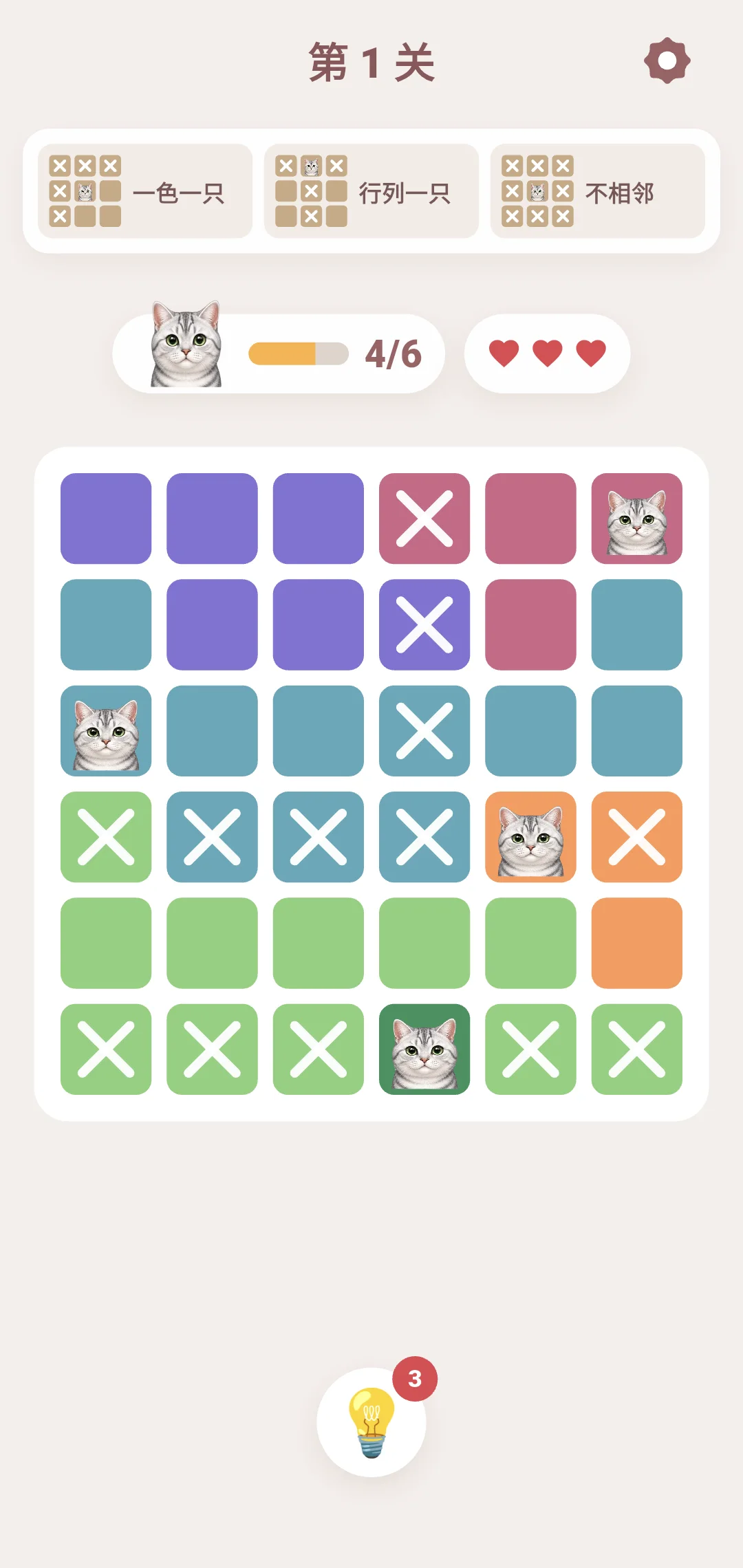


Why does it feel familiar to Sudoku players?
Sudoku asks every row, column, and box to obey a uniqueness rule. PetQuest uses the same kind of constraint thinking: one pet in every row, one in every column, and one in every colored region. Progress comes from removing impossible squares, not from tapping at random.
When a row, column, or region has only one candidate left, that pet is forced. The board becomes easier as each confirmed position eliminates more options, creating the same satisfying cascade that makes a good Sudoku solve click into place.
How is it different from classic Sudoku?
Classic Sudoku usually fills a 9×9 grid with the digits 1–9 and repeats the same 3×3 box structure. PetQuest uses no numbers, and its irregular colored regions change shape from level to level. You have to notice how each region crosses several rows and columns.
The diagonal rule is also easy to overgeneralize. Pets may not touch at a corner, but an entire long diagonal is not forbidden. Think “leave one square of personal space,” not “apply every chess queen attack line.”
How should a beginner start?
Begin with the smallest or narrowest color region and count which rows and columns can still hold its pet. After confirming a pet, mark its row, column, region, and all eight neighboring squares with Xs.
If nothing is forced yet, compare two nearby regions and the lines they must occupy. Look for a row, column, or color that has only one legal square. PetQuest also includes a lightbulb hint that can reveal one correct position when you need a nudge.
Who is this Sudoku-like puzzle for?
It suits players who enjoy Sudoku logic but want a break from digits, people who prefer short visual puzzles, and anyone who likes a calm cat-and-dog theme more than a clinical number grid.
PetQuest includes 2,000 offline levels. The three rules stay consistent while the shapes and candidate relationships change, so the game is quick to learn without turning every board into the same routine.